
PAC MONEY FLOODS MAUI, SUGIMURA CAMP
La Costa News Center • Special Report
Outside Money Floods Maui
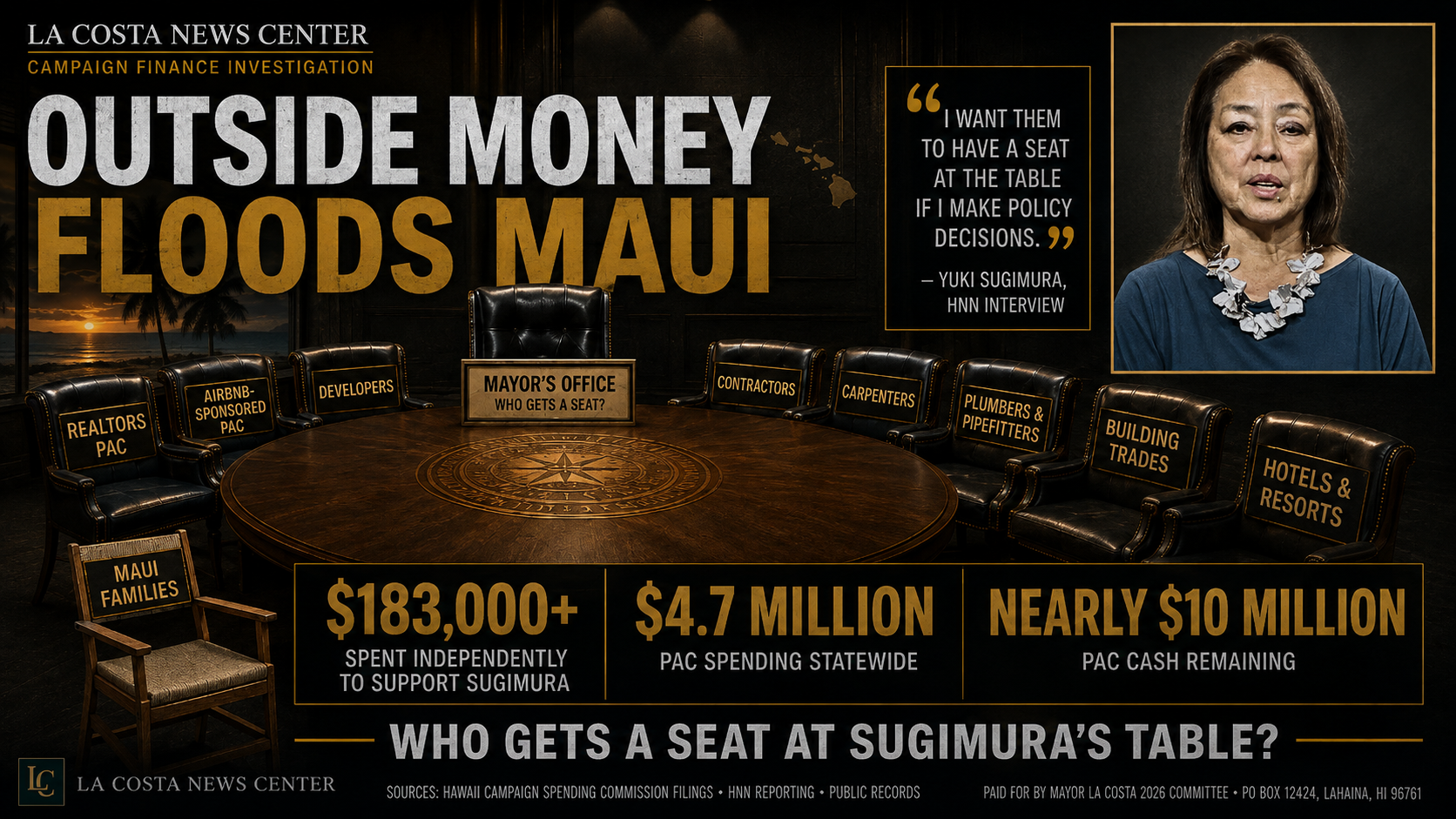
Realtors. Airbnb. Developers. Contractors. Carpenters. Plumbers. A construction-backed super PAC has spent more than $183,000 promoting Yuki Sugimura—on top of a donor network, industry endorsements and a public record that reveal who is already reserving a seat at her policy table.
Before Maui voters choose their next mayor, some of the industries with the most at stake in the island’s next chapter are already choosing sides.
The Hawaiʻi Realtors PAC has endorsed Yuki Lei Sugimura and supported five of her six campaigns.
An Airbnb-funded political committee contributed to her mayoral campaign.
Developers, land-company executives, contractors and real-estate interests appear throughout her donor ledger.
Political funds associated with carpenters, plumbers and pipefitters, laborers, electrical workers and other building interests have contributed directly.
And now the most financially powerful organization in that coalition has entered the race at full strength.
New campaign-spending reports show that For a Better Tomorrow, the political action committee affiliated with Pacific Resource Partnership and primarily funded by the Hawaiʻi Regional Council of Carpenters and contractors, has spent more than $183,000 independently promoting Sugimura for Maui mayor.
That is not the organization’s total political spending.
For a Better Tomorrow has poured approximately $4.7 million into Hawaiʻi’s 2026 primary elections and still has nearly $10 million available. Its investments include roughly $2 million supporting Kauaʻi Mayor Derek Kawakami for lieutenant governor, almost $119,000 supporting former Kauaʻi Mayor Bernard Carvalho’s effort to reclaim that office, money behind legislative candidates—and a six-figure effort to install Sugimura in Maui County’s most powerful office.
University of Hawaiʻi political scientist Colin Moore described the operation to Hawaii News Now as “mainland style, major league politics.”
But the most revealing words may have come from Sugimura herself.
Speaking about the range of people, groups and industries she has been consulting, she told HNN:
“All of these people I am talking to—in terms of groups and industries—I want them to have a seat at the table if I make policy decisions.”
The full statement matters. Sugimura presented the idea as broad consultation, not as deference to any one donor or institution.
But so does the context.
Some Maui residents approach government through a three-minute public-comment period.
Some wait hours for an agenda item after taking time away from work or family.
Others arrive represented by trade associations, political committees, lobbyists, professional fundraisers—and hundreds of thousands of dollars in campaign promotion.
The table is not being set after the election.
It is being set now.
This is not a story about one check
No campaign contribution proves that a vote was purchased.
No independent expenditure proves coordination. For a Better Tomorrow is legally prohibited from coordinating its advertisements with Sugimura’s campaign.
That is not the point.
The point is the coalition being assembled around her, openly and legally, before Maui voters decide who will lead the county.
The Realtors Political Action Committee.
An Airbnb-sponsored political committee.
Hotels, resorts and timeshare interests.
Developers and land companies.
Contractors and construction executives.
Carpenters, plumbers, electricians, laborers and other building trades.
And now a super PAC capable of spending more to promote Sugimura than many Maui candidates could raise for an entire election.
Together, those records pose a question far larger than whether any single contribution complied with the law:
When Sugimura promises industries a seat at the policy table, which interests have already spent the most to reserve theirs?
The PAC did not arrive alone
The $183,000 independent campaign sits atop a Sugimura fundraising operation already unlike any of her previous races.
A Mayor La Costa 2026 analysis of state campaign-finance filings identified $319,303.50 in itemized mayoral contributions through June 30. Slightly more than half was reported from mailing addresses outside Maui County, including more than $114,000 from Oʻahu and nearly $45,000 from the mainland.
The geographical split is notable.
The composition of the money is more revealing.
Political funds associated with the Carpenters, Laborers, Masons, Plumbers and Pipefitters, electrical workers and a labor-management cooperation trust supplied more than $23,000 directly to Sugimura’s campaign, according to the campaign’s filing review. Independent reporting corroborates roughly $20,000 of that amount; the remainder is drawn from the underlying filings retained with the article’s records.
The real-estate, development and land ledger includes interests associated with Maui Lani Partners, Stanford Carr, the Kobayashi Group, Fergus & Company, F&W Land Company, Continental Properties, Rak Equities, STF Land and Pacific Rim Land. Several contributors gave the $4,000 maximum.
The Hawaiʻi Realtors PAC has supported Sugimura in five of her six campaigns, according to the filing history reviewed by the La Costa campaign, and formally endorsed her for mayor this year.
An Airbnb-funded political committee, the Committee to Expand the Middle Class, also appears among her mayoral donors.
Hotels, lodging associations, resorts, timeshare interests and visitor-industry political funds recur throughout Sugimura’s campaign history. The Hawaiʻi Lodging & Tourism Association’s HotelPAC contributed in each of her five council election cycles, while the national timeshare industry’s political organization gave across four election periods.
By the research team’s strictest classification—counting only contributors whose names or reported employers explicitly identify them with real estate, land, development, construction or building trades—at least $95,579, approximately 30% of the analyzed itemized money, came from those sectors.
That is a documented floor, not a claim about every donor’s motive or affiliation.
And it is separate from the more than $183,000 For a Better Tomorrow has spent independently promoting her.
A statewide political portfolio
The Sugimura expenditure cannot be understood in isolation.
For a Better Tomorrow has built a statewide political portfolio.
It has spent approximately $2 million promoting Kawakami for lieutenant governor—nearly three times what his own campaign reportedly spent.
It has put almost $119,000 behind Carvalho’s return as Kauaʻi mayor.
It has invested in legislative races across Oʻahu.
And it has spent more than $183,000 promoting Sugimura on Maui.
These candidates occupy different offices and run separate campaigns. The PAC’s spending is independent.
But the investment strategy is coherent: elect candidates whom construction organizations and building trades regard as compatible with their priorities.
There is nothing inherently improper about that.
Unions exist to represent their members. Contractors and construction workers have legitimate interests in infrastructure, employment, housing and wildfire recovery. Maui cannot rebuild Lahaina or address its housing shortage without the people who finance, design, permit and construct what comes next.
But this is not merely a few Maui carpenters passing a hat.
It is an organization with nearly $10 million available, spending millions to shape leadership across multiple islands and levels of government.
HNN reported one notable tactical change: after suffering reputational blowback from aggressive negative campaigns in earlier elections, the organization has avoided attack advertising this cycle.
The political operation has not become smaller.
It has become more polished.
The Realtors, Airbnb and the visitor economy
The coalition behind Sugimura extends beyond construction.
The Realtors PAC has formally endorsed her for mayor.
The Realtors Association of Maui opposed Bill 9, the ordinance phasing out thousands of grandfathered vacation rentals in apartment-zoned districts. Sugimura voted against Bill 9 on both readings.
She later supported Bill 88, which created a proposed pathway for certain affected properties to seek hotel zoning. Sugimura called it “a great solution.”
But the full context matters.
Bill 88 was not merely Sugimura’s initiative or a measure advanced by Bill 9 opponents. Mayor Richard Bissen strongly supported it as an implementation step following Bill 9. Council Members Tamara Paltin and Shane Sinenci—two prominent Bill 9 supporters—also voted to advance it. The measure passed first reading 7–2, with only Gabe Johnson and Keani Rawlins-Fernandez opposed.
That context weakens any simplistic claim