
The Lahaina Fire: The Untold Story of How Bissen and Sugimura Failed Us.
Mayor La Costa 2026
La Costa News Center
Accountability • Research • Maui Issues
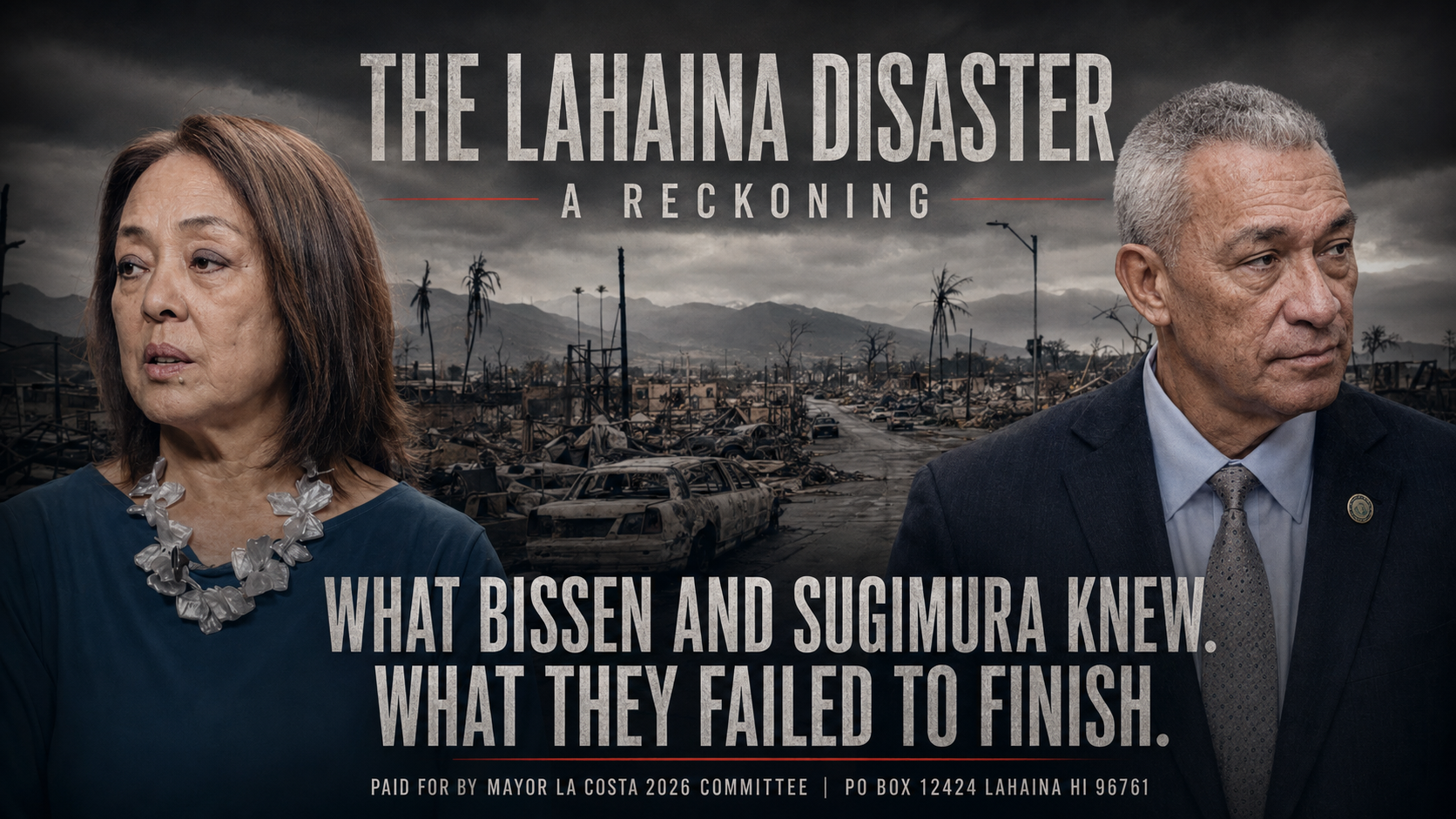
The Lahaina Disaster– by the La Costa research team.
A Reckoning: What Bissen and Sugimura Knew — and Failed to Finish
Maui was warned before Lahaina burned. Richard Bissen inherited the emergency system that failed. Yuki Lei Sugimura helped oversee the budgets and the legislative machinery during the five years between the warning and the catastrophe. Their records — not speculation — show what happened next.
La Costa News Center • Accountability Report • Maui Mayor’s Race
This report was compiled by the Mayor La Costa 2026 campaign from Maui County Council minutes, budget ordinances, legislative files, the Hawai‘i Attorney General’s official timeline and letters, the Maui County 2023 Wildfire After-Action Report, the Fire Safety Research Institute investigation, and contemporaneous reporting by Honolulu Civil Beat, Hawaii News Now, KITV, the Maui News, Maui Now, Hawai‘i Public Radio, the Honolulu Star-Advertiser, NBC News, and Maui Alert.
One hundred and two people died in Lahaina on August 8, 2023. Neither Richard Bissen nor Yuki Lei Sugimura caused that fire. What they knew, what authority they held, and what happened during the five years between Maui’s warning and its catastrophe are different questions — and the answers are written not in speeches but in official minutes, roll-call votes, budget ordinances, sworn timelines, and public admissions.
In the fall of 2018, residents packed a community meeting at Lahainaluna High School. Weeks earlier, firefighters had defended the campus as flames came up the hill and blackened the practice field. Lahaina had escaped. The people in the room understood how close the town had come.
They asked why no emergency alert had reached their phones. Why the sirens had not sounded. Why firefighters had lost access to water. Why there was no evacuation plan they could identify. Why the electric utility had not shut down its lines during dangerous winds. Alan Arakawa, then Maui County’s mayor, was in the room. NBC News later reported his assessment: they could have lost most of Lahaina. Tamara Paltin was there too — a county lifeguard, not yet a councilmember. She warned that if another fire started, many Lahaina residents could be trapped.
On August 8, 2023, the same broad categories failed again. Public warning. Evacuation. Water. Electrical infrastructure. Emergency coordination.
They did not ignore it
The simplest version of this history would say Maui was warned and its government did nothing. The public record shows something more complicated, and more troubling.
Officials held meetings. Councilmembers asked questions. An audit was performed. The Fire and Public Safety Commission submitted an evaluation. Paltin won a council seat and pressed officials about evacuation routes, hydrants, and emergency planning.
Maui also had a formal mechanism for turning a disaster into corrective action: the after-action report. But the Fire Department never initiated one for the 2018 fires. The Police Department did not produce one. The Emergency Management Agency began a report and never completed it. The 66-page draft was designated “For Official Use Only.” It did not meaningfully address the failures Lahaina residents had raised — alerts, sirens, water, evacuation, power lines. It became public in October 2023, after journalists requested it, and after Lahaina was gone.
By April 2019, the council was openly discussing whether the physical center of Maui’s emergency response was itself inadequate. Budget Chair Riki Hokama called for a “smarter, 21st Century” emergency operations center and said the existing basement facility raised serious workplace concerns. Managing Director Sandy Baz acknowledged that minor renovations had helped but that Maui needed substantially more space, modern technology, redundancy, and the ability to keep operating during a disaster.
The instruments of government were used. The warnings were heard, across more than one system. The county took actions, but the core deficiencies later identified in warning, staffing, command, and coordination remained unresolved.
Sugimura: A position of responsibility
Yuki Lei Sugimura joined the Maui County Council in January 2017. During the 2017–2019 term she chaired the Policy, Economic Development and Agriculture Committee. Its official docket included a January 2018 presentation on Maui County emergency-preparedness plans.
She was not a spectator to the county’s preparedness discussions. She held a committee chairmanship, participated in the annual budget process, and had access to legislative tools that included hearings, reports, budget amendments, resolutions, and requests for administrative action. Maui councilmembers hold residency-area seats but are elected countywide. Sugimura’s residency area was Upcountry. Her constituency included Lahaina.
“Crossing our fingers”
On the morning of April 2, 2018, during the Budget and Finance Committee’s review of the Fire Department’s budget, Sugimura asked Fire Chief Jeffrey Murray a question. It is preserved, word for word, in the committee’s official minutes.
She wanted to know what the end of Hawaiian Commercial & Sugar’s plantation operations would mean for fighting brush fires. “I used to think that they would always help when there was a brush fire,” she said, “and what is the impact of that if there is any?”
It was, Murray told her, “a[n] extremely good question.” The plantation had “only 14 people that work for them now.” Its help “will never be the same as it was in the past and that could become problematic for us.” When the plantation crews had worked the fields, he said, “they were very quick to show up.” Now response “may take hours, you know, in excess of four hours, depending on what side of the island they’re on.”
“So,” the chief said, “crossing our fingers.”
It was one of the most consequential warnings placed into Maui County’s public record before the Lahaina catastrophe. Roughly 36,000 acres of former cane land had gone fallow. State investigators would later identify inactive agricultural land, unmanaged vegetation, and invasive grasses among the major contributors to Maui’s wildfire risk and to the speed at which the August 2023 fires spread.
The same hearing exposed two separate limitations. Asked whether the county’s operational brush-fire money could be used preventively — to cut firebreaks ahead of an event — Murray said the department preserved that funding for actual incidents rather than preventive work: “when we need it, we want to be able to access it for real fire.” Separately, Chair Hokama noted that the Fire Hazard Removal Fund projected “no anticipated revs” for the coming fiscal year. One exchange later, Sugimura turned to a different line item — an increase for radio bank and desk chargers under Miscellaneous Supplies.
The council cut
The emergency-management staffing decision that followed is documented in the budget record. Mayor Arakawa’s proposed FY2019 budget would have kept the Emergency Management Agency at 6.75 equivalent personnel. The administration did not propose reducing it.
The adopted budget came in lower. During the council’s budget process, the 0.75-equivalent Civil Defense District Coordinator position was eliminated, and the authorized level fell to 6.0. The full FY2019 budget passed the council 8–0, with Council Member Kelly King excused. Sugimura was among the eight voting yes.
That vote does not establish that Sugimura personally proposed the reduction. It does not establish that one fractional position would have prevented either the 2018 near-miss or the 2023 catastrophe. The record establishes only what it establishes: the administration proposed 6.75, the adopted budget was 6.0, and the eliminated position was not a firefighter or an incident commander. Its title was Civil Defense District Coordinator.
The direction of the decision is not in dispute. The mayor proposed maintaining the agency’s staffing. The budget the council adopted reduced it.
The near-miss
Lahaina nearly burned several months later. Eleven weeks after that fire, the Fire Department returned to the council, and Sugimura returned to the subject of wildfire. Chair Hokama turned to her and identified her as “the subject matter chair.”
Whenever Fire came before the committee, she said, she wondered about Kula — its comparatively small station, the 36,000 acres of open land abutting residential areas, and the concern in her community. She asked to see future appropriations for the Kula station.
The concern was genuine. So was the authority she held. The question is not whether Sugimura recognized the danger. The record shows plainly that she did — clearly, and years before August 2023. The question is what sustained protection followed from that recognition.
The report that was never finished
The county’s after-action report on Hurricane Lane and the 2018 fires was never completed and was not released for more than five years. KITV later confirmed that the Emergency Management Agency, under its administrator, declined to publish it. When the 2023 Lahaina fire finally forced the question, the state’s own emergency-management agency could not even confirm the review had been done: HI-EMA spokesman Adam Weintraub told Civil Beat in October 2023 that the state had “no information that such a report exists.” The county’s copy surfaced only that same month, under public-records requests, after Lahaina had burned. By then a complete turnover had swept the county agency: of the staff who had been through the 2018 emergency, only the administrator remained.
The file
Return to the spring of 2019. Eight weeks after that budget hearing, Sugimura initiated a legislative communication on hurricane and emergency-management preparedness. It became County Communication 19-264 and was referred as item PSLU-35 to the Planning and Sustainable Land Use Committee. Her name is on it. She used a legislative instrument.
The available committee record does not show that instrument producing a hearing, a committee report, an ordinance, a resolution, an appropriation, or a reporting deadline. PSLU-35 does not appear among the matters the committee carried forward on its end-of-term referral list. The item’s individual legislative history is the definitive record of its fate, and no evidence located for this report shows it was heard or completed before the 2019–2021 term ended.
Tamara Paltin chaired that committee and controlled its agenda. Sugimura did not have unilateral power to schedule the item. That distinction matters — and so does the question that follows it: after opening the file, did she ask that it be heard, seek a deadline, submit draft legislation, request an agency report, pursue it through the budget, or reintroduce it when the term expired?
The record establishes that Sugimura initiated the item. It does not establish the completed protection that resulted from it before August 8, 2023.
The arithmetic
Maui’s emergency-management agency is not a metaphor. Its staffing appears as a number in the county’s annual budget ordinances. The authorized series from FY2015 through FY2024:
Authorized staffing — equivalent personnel, FY2015–FY2024
6.0 · 6.0 · 6.75 · 6.75 · 6.0 · 7.0 · 9.0 · 9.0 · 9.0 · 9.0
The FY2019 reduction to six was the only reduction in the series. The agency held at nine for the four budgets preceding the fire — the last adopted about six weeks before August 8, 2023.
How many of the nine positions were filled that day is a separate question; authorized positions are not staffed positions, and a full accounting requires vacancy and payroll records. But the authorized ceiling is a matter of public record, and for four straight budgets it did not move.
The equipment record needs the same precision. Across the ordinances reviewed, the agency’s designated general-fund equipment appropriation was zero. That does not mean it had no equipment — federal and state grants funded equipment and preparedness work through separate accounts. It means the county’s adopted general-fund budget repeatedly provided no dedicated equipment money to the agency responsible for warning and emergency coordination.
The current staffing cap is 25 positions, funded at more than $4 million — nearly triple the authorized positions and roughly 3.6 times the funding in effect when Lahaina burned. That expansion reflects Maui County’s post-fire decision to build substantially more emergency-management capacity.
Sugimura has served on the council since 2017 and participated in every county budget from FY2018 forward. She now chairs the Budget, Finance and Economic Development Committee and presents her command of county finances as a central qualification for mayor. That makes the budget record central to evaluating her candidacy, not incidental to it.
She saw the danger. She elicited the warning. She voted for the budget in which the council reduced emergency-management staffing below the mayor’s proposal. She later opened a preparedness file. What remains missing is the completed result.
Bissen: The mayor in the building
Richard Bissen’s strongest defense is also true. He had been mayor for roughly seven months when Lahaina burned. He inherited the county’s emergency plans, its staffing structure, its departmental leadership, its warning systems, and decades of accumulated wildfire risk. He was not commanding firefighters in Lahaina. No official investigation reviewed for this report attributes the decision not to activate the sirens to him, and no public evidence shows he ordered a warning withheld.
But tactical command and executive responsibility are not the same thing.
Maui County’s own after-action report states that Hawai‘i law makes each county mayor responsible for organizing, administering, and operating the county emergency-management agency and its operations center. The report’s first major finding calls for clearer executive direction from the Mayor’s Office during an activation. That does not make Bissen the incident commander. It establishes that emergency management sat inside his executive chain of responsibility on August 8 — not only after the fire ended.
Seven months was a limited period in which to diagnose and rebuild an inherited system. It was not no responsibility for that system.
The emergency was already underway
By the morning of August 8, Maui was not facing a hypothetical danger. The National Weather Service had posted the specific fire-weather threat the day before, and a red-flag warning was in effect: dry fuel, low humidity, and hurricane-driven trade winds forecast to gust past 60 miles an hour. Those winds were already tearing down utility poles across the island — dozens of them, with thousands of West Maui customers losing power and communications strained — and fires were already burning on more than one front, in Upcountry and above Lahaina, before the afternoon Lahaina fire accelerated into an urban catastrophe.
Senior emergency leadership was also unusually thin. Four days after the fire, Honolulu Civil Beat reported — citing Maui County Communications Director Mahina Martin — that neither the county’s fire chief nor its top emergency-management official was on the island as the wildfires burned. Emergency Management Administrator Herman Andaya, whose agency was responsible for county warning and evacuation coordination, was at a conference on O‘ahu. Fire Chief Brad Ventura was also off island, and did not return to Maui until the morning after the fire. Maui Alert’s reporting through 2023 and 2024 tracked the same pattern of dispersed leadership and shifting official accounts.
Their deputies and personnel remained on duty, and their absence does not mean the departments stopped operating. Firefighters and officers fought through the day, many while their own homes burned. But it does mean Maui entered an extraordinary, multi-front emergency without two of its highest-ranking public-safety officials physically present.
The mayor was not in the command center
Against that background, Bissen’s own absence from the emergency operations center carries greater weight.
Richard Bissen was present at the county complex for much of August 8. In a televised address weeks later, he said he reached the emergency operations center around 6:30 a.m. and was there, with senior staff, working late into the night.
The record complicates that account in one decisive respect. As the afternoon fire was overrunning Lahaina, Bissen was not in the command center. Around 3:15 p.m., the operations-center staff confirmed the mayor was not in the room. At 3:32 p.m., he texted the emergency-management administrator: “Let’s stay on top of this. I’m coming back up after my Dr. appt.” He had stepped away from the operations center for a medical appointment during the very window the fire exploded into an urban firestorm.
The county’s explanation of that absence changed over time. Its first account said the appointment had been canceled. After the Attorney General’s timeline documented the 3:32 text, the county acknowledged that Bissen had, in fact, stepped away from the operations center and attended the appointment. Maui Alert, which pressed the question in a series of reports, was first to document that the mayor’s office had acknowledged he was not in the command center at critical times “despite its earlier statements to the contrary.”
Who was running the response in his absence was itself unclear. The emergency-management administrator with authority over sirens and evacuation, Herman Andaya, was at the conference on O‘ahu that entire day. Asked afterward who had been in charge at the operations center, Bissen said: “I’m not sure who was in charge. Herman Andaya was still in charge. He just wasn’t present.”
The county also could not fully document its own actions. During the Attorney General’s investigation, the state sought an August 8 operations-center sign-in sheet the county could not locate, though a witness reportedly recalled signing one. Only three of the standard incident activity logs dated August 8 were found; dozens were created in the days and weeks afterward.
Maui entered its worst hour with its senior emergency leadership dispersed and its command structure unclear.
None of this establishes that Bissen personally caused the disaster or that his presence in the room would have changed the outcome. It establishes something narrower and still serious: the county’s chief executive was away from the command center at the decisive hour, the man nominally in charge was on another island, and the mayor’s own account afterward — “I’m not sure who was in charge” — reflected real uncertainty about who was directing the response.
The failure upward
Around 6 p.m., Bissen gave a live public update based on what he called the best information then available to county leadership. “I’m happy to report that the road is open to and from Lahaina,” he said. He did not tell the public that Lahaina had suffered mass casualties. Officers on the ground had already encountered indications that people had died. Bissen later said no fatality report had reached him.
The road statement was not a fabrication. Contemporaneous county updates that day reported that Hōkiokio Road had been cleared to allow cars out of the Lahaina area. The road update was a fragment of accurate information arriving inside a system that had failed to communicate the larger reality. The problem was not dishonesty. It was that Maui’s chief executive could report a road opening while remaining unaware that Lahaina had suffered mass casualties.
There is no evidence he knowingly gave false information. There is evidence of a profound institutional failure: facts of enormous consequence, known on the ground, were not reaching Maui’s chief executive quickly enough for him to tell the public what was happening to Lahaina.
The official investigations describe the machinery behind that failure. The Fire Department did not establish a formal command team. Incident commanders were overwhelmed. Fire and police never connected to form unified command. The operations center did not fully activate until 4:30 p.m., roughly 95 minutes after the fire reignited. The county lacked a practiced, reliable way to move critical information from the field, through departmental operations centers, and into the central emergency operation.
Those were multi-agency failures. They cannot all be converted into personal acts by the mayor. They happened inside the executive branch he led.
The records after the fire
In February 2024, Attorney General Anne Lopez wrote to Bissen directly, accusing the county of “delay and evasion” in producing records her investigators believed existed. Her letter named specific categories of missing August 8 material — operations-center sign-in sheets, ICS-214 activity logs, maps, notes, and situational-awareness-board records — and warned that the state would “seek court intervention” if compliance did not improve. Maui County denied obstructing the investigation and reported producing 18,742 files, 46,105 pages, more than 118 gigabytes of material, and access to more than 150 interviews.
The production was substantial. The gaps were also real. Nothing public shows Bissen ordered anyone to conceal or destroy evidence, and missing sign-in sheets are not proof of a cover-up. They are evidence that Maui County could not consistently create, preserve, or retrieve the documentation needed to reconstruct its own actions during the deadliest disaster in modern Hawai‘i history. That is an accountability failure even without a crime.
The reforms
After the fire, Maui County increased emergency-management staffing and published an after-action report and improvement plan. In his 2025 State of the County address, Bissen said the Emergency Management Agency had grown from nine employees to 22; by his 2026 address, the figure was 25. That growth is in the emergency-management agency itself — a separate matter from the pace of rebuilding homes and businesses, which runs through different departments and funding. Both are measurable actions.
The plan also showed how much remained undone. When it was published in January 2025, several of its highest-priority actions were marked “Not Started” in the county’s own document — among them directives to “develop and issue an Executive Order” defining departmental emergency-management responsibilities, to “create a roster of staff” trained for operations-center roles, to establish “pre-event contracts to bolster EOC staffing,” and to “implement a staffing plan” for command and general-staff functions. The county described the plan as a living document whose status would be updated; a later public version showing the disposition of every action item has not been located for this report.
The question for Bissen is no longer whether the county recognizes the deficiencies. Its own report recognizes them. The question is which reforms have been funded, exercised, and completed — and which remain commitments on a page.
The recovery
The recovery is moving. Measured against what was lost, it has barely begun.
The August 2023 fire destroyed more than 2,200 structures, the large majority of them homes; the U.S. Army Corps of Engineers cleared roughly 1,400 residential lots in the burn zone. As of July 6, 2026 — nearly three years later — Maui County reported 236 completed rebuilds, with 574 permits issued and 315 homes under construction. Measured against the residential lots cleared, completed homes stood at roughly one in six; measured against the full scale of destruction, closer to one in ten. Either way, the great majority of what burned had not been rebuilt.
The more revealing number is the trajectory. Eighteen months after the fire, six houses had been rebuilt. At the two-year mark, the count was still under fifty — about two percent. Only in late 2025 and 2026 did rebuilding accelerate: completions roughly doubled in the first half of 2026 alone. The acceleration the administration points to is real. It also arrived in the third year, after eighteen months in which almost nothing rose from the burn zone — a delay driven by permit approvals that averaged around 200 days, coastal-review requirements that took a year to waive, insurance shortfalls, and a settlement whose first payments slipped into 2026.
Hundreds of families were still waiting to go home. As of early 2026, roughly 650 households remained in temporary housing and several hundred more relied on rental assistance; the federal housing program, twice extended, was pushed to February 2027.
Front Street tells the sharpest version of the story. The county announced the historic street would “reopen” on August 1, 2026 — but the reopening is of the road to vehicular traffic, following seawall, sidewalk, and paving work. The commercial core behind it remains largely empty ground. Nearly three years after the fire, five commercial building permits had been issued in the district, one project was under construction, and none of the destroyed downtown businesses had been rebuilt on their original lots. The first storefronts scheduled to return are not permanent rebuilds at all, but an interim marketplace of retail stalls and food trucks.
The owners describe a punishing process. Kimo Falconer, whose family built Lahaina’s Pioneer Inn: “Now we are two and a half years after the fire. Nobody on Front Street has built anything.” Meri-Jo Abrams Manuel, 77, a Front Street property trustee, called the process “crippling” and said she did not think she could rebuild. Of roughly 1,100 businesses in Lahaina before the fire, hundreds had reported zero employees a year later; of the harbor’s displaced companies, a small fraction had returned.
Bissen has not disputed that the commercial core came last, and he has defended the sequence. His administration, he said, made a deliberate choice to rebuild homes for displaced residents first — “we have never forgotten the commercial properties,” but businesses, in his own words, “took a backseat.” “We made that no secret,” he said. Whatever the merits of that priority, its consequence for Front Street’s owners was years of waiting: his west-side council colleague, Tamara Paltin, warned that local landowners in disaster forbearance “are getting foreclosed upon” while the county moved without urgency.
An honest ledger records the acceleration and the scale together. The residential rebuild is finally gaining speed. It is also, three years on, roughly a tenth complete, with hundreds of families still displaced and the commercial heart of the town still a fenced ruin behind a freshly repaved road.
What this is not
No evidence reviewed places Richard Bissen in tactical command of the fire. None places him behind the decision not to activate the sirens. None establishes that he knowingly misled the public about the dead, or that he ordered records concealed or destroyed.
Yuki Lei Sugimura did not single-handedly defund emergency management. She was one of nine councilmembers, the FY2019 budget ran to hundreds of millions of dollars, and the record does not establish that she personally proposed eliminating the Civil Defense District Coordinator position. No evidence establishes that keeping it would have prevented what happened in 2023. She also asked the fire chief the question that produced the warning, and she opened a legislative file on emergency preparedness. Those facts are hers, and they belong in the account as surely as the vote does.
State investigators concluded that Lahaina’s destruction resulted from interacting failures — preparedness, vegetation, electrical infrastructure, warning, evacuation, command, and interagency coordination — accumulated over many years. The investigation’s own director said the devastation “cannot be connected to one specific organization, individual, action, or event,” and that the conditions “were years in the making.” They also found the emergency-management agency lacked sufficient personnel and resources for the missions it had been assigned. Assigning that responsibility completely requires records still not public: what the agency requested, what each mayor proposed, what the council amended, who proposed each change, which positions were vacant, what money went unspent, what grants bought, which reforms were exercised, and which warnings produced completed action.
Those questions can still be answered.
The interval
What is already established is enough to define the choice voters face.
Lahaina residents told the county what had failed. A council committee received an emergency-preparedness presentation. Sugimura asked the fire chief what the loss of plantation crews would mean, and the chief warned of response times exceeding four hours and said the county was crossing its fingers. The mayor proposed maintaining emergency-management staffing. The adopted budget reduced it. Lahaina nearly burned. One councilmember pursued hydrants, evacuation routes, and the unfinished after-action report. Sugimura opened another preparedness file. No completed result from that file has been identified before the term expired. The agency stayed authorized for nine positions across four consecutive budgets. On August 8, 2023, warning, evacuation, command, and information-sharing failed again.
The mayor was not the incident commander, but the system was inside his executive branch. The councilmember did not control the administration, but she had spent years presenting mastery of the county’s budget and legislative process as her central qualification.
Neither candidate caused the fire. Both now ask Maui voters to trust their government experience with Maui’s next four years. Experience is not the number of years someone held an office. It is what the record shows was finished while the authority was theirs.
During the five-year interval, Maui County held meetings, asked questions, conducted audits, opened files, and adopted budgets. Then the same systems failed again. Nothing in that chronology requires a conspiracy. That is what makes it an indictment.
Maui does not need another warning. It does not need another file. It needs a government that finishes the work.
Principal records and reporting: Policy, Economic Development and Agriculture Committee item PEA-1(6) (Jan. 16, 2018); Budget and Finance Committee minutes, April 2, 2018 (9:01 a.m., Council Chamber), and November 13, 2018; Mayor’s Proposed FY2019 Budget, Emergency Management Agency Department Summary (Maui County DocumentCenter Index 111973); Adopted FY2019 Budget (8–0, Council Member King excused); Water and Infrastructure Committee minutes, February 25, 2019; Economic Development and Budget Committee minutes, April 22, 2019; County Communication 19-264 / PSLU-35; Maui County operating-budget ordinances, FY2015 through FY2026; KITV/Island News on the 2018 Hurricane Lane after-action report; Honolulu Civil Beat (Oct. 22 & 25, 2023), quoting HI-EMA spokesman Adam Weintraub; NWS Honolulu red-flag warnings, Aug. 6–8, 2023; Hawaii News Now, ABC News, and NBC News on Aug. 8, 2023 conditions; Honolulu Civil Beat, “Maui’s Top Emergency Officials Were Off Island As Wildfires Hit Lahaina” (Aug. 11, 2023); Hawai‘i Attorney General / Fire Safety Research Institute Phase One Timeline (Apr. 17, 2024); Attorney General Anne Lopez letter to Mayor Bissen (Feb. 7, 2024) and County outside-counsel response (Feb. 12, 2024); Mayor Bissen remarks, Aug. 8, 2023; news conference, Aug. 29, 2023; televised address, Aug. 31, 2023; 2025 and 2026 State of the County addresses; Maui Wildfires 2023 After-Action Report (Jan. 2025); County of Maui Rebuild Dashboard (Jul. 6, 2026); PDC/FEMA damage assessment; rebuild-trajectory reporting in Civil Beat, Maui Now, City Journal; Front Street permits and owner interviews in Hawai‘i Public Radio, the Maui News, and the Honolulu Star-Advertiser; FEMA temporary-housing extension to Feb. 28, 2027; Maui Now and Hawaii News Now on Bissen’s commercial-recovery “backseat” remarks; and Maui Alert reporting (2023–2024).
Paid for by Mayor La Costa 2026 Committee | PO Box 12424 Lahaina, HI 96761
P. Denise,
This was a sobering analysis; thank you for presenting it.
I see you’ve have commissioned additional reports that document your opponent’s sins and shortcomings. This is also appreciated.
However, what I have not learned is what you will do differently if you are elected.
Where is your comprehensive action plan for overhauling the entrenched systemic shortcomings of the executive branch?