
Sugimura’s Off Island Cash Connection
Mayor La Costa 2026
La Costa News Center
Accountability • Research • Maui Issues
Campaign Finance Investigation
Half the Itemized Money Behind Her Campaign to Lead Maui Comes From Somewhere Else
Yuki Lei Sugimura is out-raising every prior campaign in the record — but an analysis of 11 years of state filings by the Mayor La Costa 2026 research team shows a majority of her itemized mayoral fundraising was reported from addresses outside Maui County, led by Honolulu’s business and building establishment. The Realtors’ political arm has backed five of her six campaigns — $12,000 in all, capped by its largest-ever check this June — while her council record runs through a decade of no votes on binding affordable-housing measures, including three lone dissents on one West Maui workforce project and a yes to cut another project’s affordable requirement from 700 homes to 288.
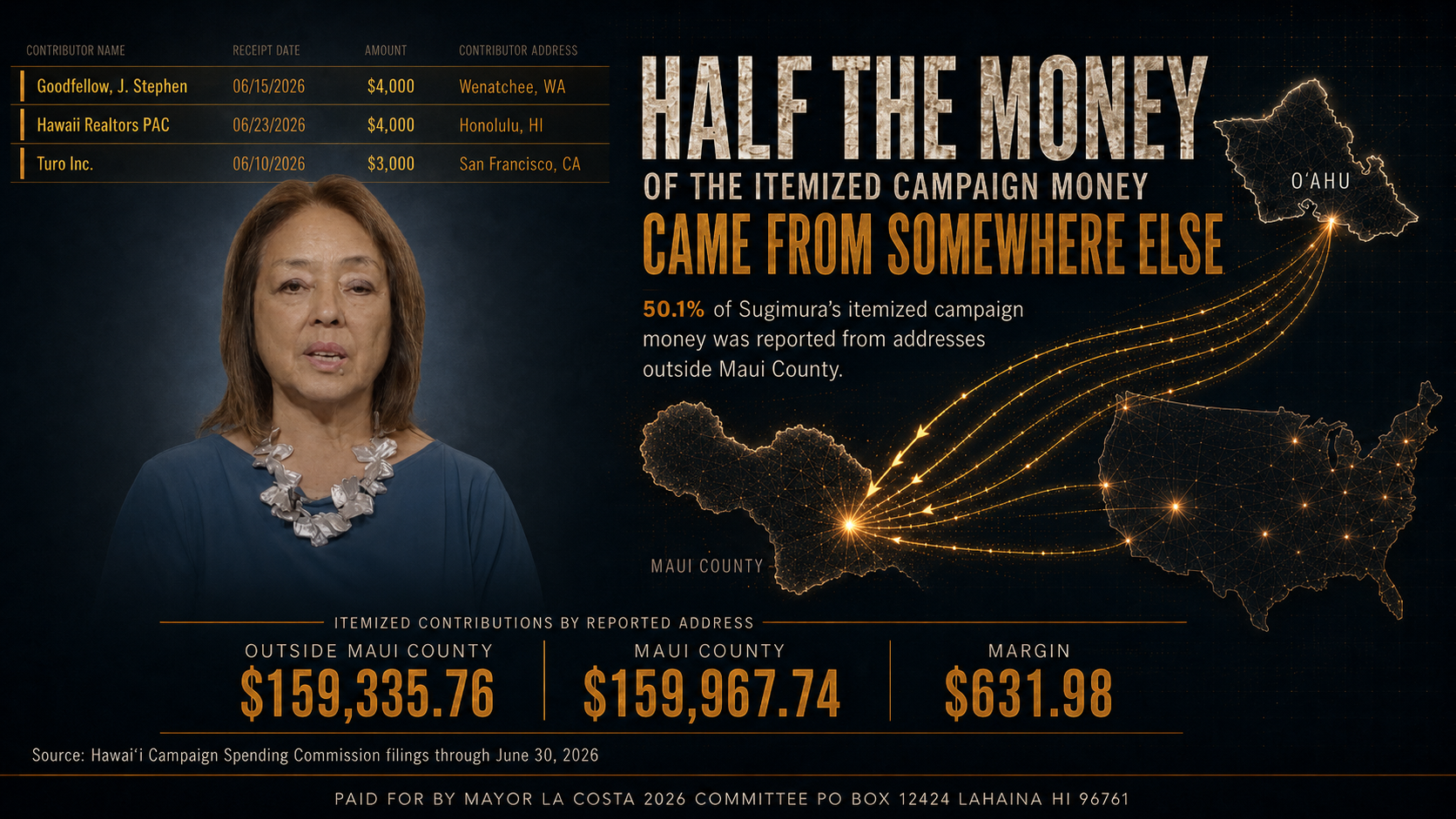
WAILUKU, Hawaii — More of Yuki Lei Sugimura’s itemized mayoral money was reported from outside Maui County than from within it.
The margin was only $631.98. The scale was not. Of $319,303.50 in individually disclosed contributions to her campaign for mayor, $159,967.74 carried mailing addresses beyond the county she seeks to lead. Oahu alone accounted for $114,342.74 — more itemized money than the file records for any entire prior Sugimura campaign. Mainland addresses supplied $44,875 more, from California, Washington, Utah, Nevada, Oregon, Idaho and Virginia.
And the money often arrived in clusters. On June 15, the chairman of Goodfellow Bros., the century-old contracting firm, gave the councilwoman $4,000 — the maximum state law allows for a Maui mayoral candidate — from the Wenatchee, Wash., mailing address he has reported across four election cycles. The same day, a retired member of the same family gave $4,000 more, and so did a project manager at the development firm Dowling Co. Eight days later, the Hawaii Realtors PAC, filing from Honolulu, added another $4,000 — the largest realtor-industry contribution across her six campaigns in the file, and the PAC’s fifth check to her under its current and former names, $12,000 in all.
Those are the central findings of the research team’s analysis of 1,006 itemized contributions reported to the Hawaii Campaign Spending Commission between January 2015 and June 30, 2026. Sugimura’s committee has reported roughly $335,000 in total contributions this cycle, per Honolulu Civil Beat — more than any prior campaign on record. The itemized transactions analyzed here, the only ones whose geography the public file discloses, account for $319,303.50 of it — and of that money, 50.1% was reported from outside Maui County, against $159,335.76, or 49.9%, from within it.
The file at a glance
$319,303.50 in itemized contributions analyzed • 50.1% reported from outside Maui County • the margin: $631.98 • Oahu alone: $114,342.74 • 98% of the money dated in calendar 2026 • 36 contributors at the $4,000 aggregate maximum • largest single entry: $20,000, from the candidate’s husband — the largest individual-person contribution identified in Civil Beat’s statewide review of first-half 2026 filings.
One limit of the data should be stated plainly: the analysis uses the mailing ZIP code reported in the filings. It does not independently establish any donor’s residence, voting address or principal place of business. A union PAC may file from a Honolulu headquarters while representing Maui workers; a company with substantial Maui operations may report a mainland address. What the filings establish is where the money was reported from — and where it was reported from is, by a margin of $631.98, mostly outside Maui County.
The tilt is not new. In every election period since 2018, the file shows more itemized money reported from outside Maui County than from within it. What is new is the scale: the total reported from outside Maui County this cycle is roughly four times that of any previous race, and it arrived fast — $312,308.29 of the total, or 98%, was dated in calendar year 2026 alone.
Honolulu’s Business and Building Establishment
The Oahu column of Sugimura’s donor file reads like a roster of the state’s business and construction leadership.
The political funds of the Hawaii Carpenters, Laborers, Masons, Plumbers and Pipefitters, two IBEW locals and the laborers-employers LECET cooperation trust — all filing from Oahu — together supplied more than $23,000.
Real estate and development money supplied a second institutional stream, running parallel to the trades. The Hawaii Realtors PAC’s maximum $4,000 — the fifth check in a $12,000 career pattern detailed below — arrived June 23. Alexander & Baldwin Inc.’s HIPAC added $500 in January, its fifth check to her across four of her six cycles, $4,500 in all. Maui Lani Partners — developer of Kahului’s master-planned community, filing from Honolulu — gave its maximum $4,000 in April, its fourth check across three cycles, $6,000 in all: even the Maui names are not always Maui addresses. And beyond the committees and entities, four more land- and development-company presidents and principals wrote maximum checks this cycle — F&W Land Company president David Ward in January, Rak Equities’ Robert Rakusin in February, Continental Properties chief executive James Schloemer in April, and STF Land Co. president Earl Stoner on June 26, three days before the reporting window closed — with Pacific Rim Land president Ryan Churchill and S&F Land developer Robert Stoner at $2,000 apiece, all per the occupations and employers listed in the filings.
Honolulu developer Stanford Carr gave $2,000; executives of the Kobayashi Group gave $4,000 between them; the two principals of Fergus & Company — Alexander and Jacob Fergus — gave $8,000 on a single January day. Paul Kosasa, chief executive of ABC Stores, and a second Kosasa family member gave $4,000 each. Russell Hata, chairman of the food distributor Y. Hata & Co., gave $4,000. Senior officers of First Hawaiian Bank and Central Pacific Bank appear in the file — among them Kirk Caldwell, the former Honolulu mayor, listed in the filings as a Central Pacific Bank senior vice president, who gave $1,000 in January and then reported two in-kind contributions in June: flights to Maui for her fundraising, $732.41 in all.
From the mainland came Matson Navigation’s $2,000, and three maximum checks from Utah, including one from a PCL Development Group general contractor.
And one developer’s money reaches both sides of the establishment. Ledcor Development LP — the Vancouver-based company behind Wailea’s 1,500-acre master-planned resort community, which completed environmental review last year for nearly 1,000 additional South Maui homes — gave Sugimura $4,000 across her 2022 and 2024 council campaigns, reported from Ledcor Development LP’s San Diego address, and gave Mayor Richard Bissen $4,000 for his current campaign, per Hawaii Journalism Initiative reporting. Sugimura’s file also holds a $2,000 check dated Oct. 4, 2024, from Wailea Resort Development LP — an entity the Wailea Hills project’s own website names as one of its operators — bearing a documented Ledcor address in downtown Vancouver, recorded in the state’s system as in-state Hawaii with a ZIP code of zero. Four weeks later, an identical $2,000 arrived under Ledcor Development LP’s name. The filings alone do not establish whether the first check was kept or returned — her committee’s expenditure filings, which are public, will answer that — and until they do, the two entries cannot responsibly be added together. None of the Ledcor money falls within her current mayoral cycle. Routine permitting is administered by executive departments, although the council retains substantial legislative authority over zoning, land use and project-related policy.
Visitor-Industry Money, Cycle After Cycle
Then there is the money from the broader visitor economy — hotels, resorts, timeshares, vacation-rental interests and, more recently, a peer-to-peer car-rental platform — a pattern Civil Beat independently noted this month, reporting that Sugimura’s support included notable contributions from real estate and tourism interests and tying at least some of it to her opposition to the county’s vacation-rental phase-out.
Across her six campaigns, Sugimura has collected $26,215 from eleven timeshare, hotel, resort and vacation-platform entities, the filings show — modest sums individually, but present in every election period in the file. One donor literally never missed: the Hawaii Lodging & Tourism Association’s HotelPAC gave in all five of her council cycles, 2016 through 2024, without skipping one. The Maui Hotel & Lodging Association’s PAC gave seven times across four cycles. The Hawaii Hotel Alliance gave in 2022 and again in 2024.
The national timeshare lobby wrote its own line in the ledger. ARDA ROC-PAC — the Washington, D.C., political arm of the American Resort Development Association, the timeshare industry’s trade group — contributed five times across four of Sugimura’s six election cycles, $4,000 in all. Its largest check, $2,000, came on Dec. 9, 2021. Its two most recent arrived on the same calendar date a year apart: July 25, 2023, and July 25, 2024.
The rhythm tightened as the county’s vacation-rental fight came to a head. On Oct. 4, 2024 — a single fundraising day — seventeen checks totaling $14,750 arrived, among them the Hawaii Realtors PAC, an IBEW local’s fund, the Hawaii Hotel Alliance, Maui Land & Pineapple’s state PAC — its fourth check across three council cycles — three members of the Dowling development family, and the Ledcor-affiliated Wailea entity. Same-day clusters are what fundraisers produce; the composition of the room is the point. The lodging money kept arriving: beginning with the Hotel Alliance’s check that day and continuing over the six weeks that followed — the Maui Hotel & Lodging PAC on Oct. 16; Marriott International’s PAC and billionaire Larry Ellison’s Lanai Resorts LLC on the same day, Oct. 23; the Hawaii Lodging & Tourism Association’s HotelPAC on Nov. 1 — five hotel and lodging entities gave $5,200, with Lanai Resorts now at five consecutive cycles, $4,750 in all.
In December 2025, Sugimura voted no on Bill 9, the phase-out, which Bissen signed into law.
The platform money came after — from two distinct corners of the visitor economy. The direct one first: in February, $4,000 arrived from the Committee to Expand the Middle Class, the political committee sponsored by Airbnb. That sponsorship is not a matter of inference. San Francisco’s Ethics Commission audited the committee under its registered name, “Committee to Expand the Middle Class, Supported by Airbnb, Inc.”; Airbnb’s own public policy staff confirmed the committee as part of the company’s efforts when it began giving to Hawaii officials in 2016; and when the same committee first gave Sugimura $200 in October 2016, her own campaign’s filing recorded the contributor’s name with “AirBNB” appended to it. Separately, Turo Inc. — the San Francisco peer-to-peer car-rental platform, a visitor-economy company but not a vacation-property business and not regulated by Bill 9 — gave $1,000 on Jan. 6, 2026, and $3,000 on June 10, the largest Turo check in her file, part of $6,000 from the company since late 2023.
None of these sums is large by mainland standards. The pattern is the point: the lodging, timeshare, resort and vacation-rental interests — those with the most direct stakes in how Maui houses its visitors — have appeared in every election period represented in the records reviewed, before, during and after the county’s defining vote on the question. The car-rental platform is the separate, newer strand.
Fewer Checks, Far Bigger Ones
Sugimura’s first countywide race, in 2016, was built the way council campaigns usually are: 311 itemized contributions averaging $326 apiece, nearly two-thirds of the money reported from Maui County addresses.
Her mayoral file inverts that profile. It contains fewer itemized contributions than that first race — 241 — but more than triple the dollars, because the average check has quadrupled, to $1,325; the median check is $500. Thirty-six contributors gave the $4,000 maximum in aggregate — the ceiling under HRS §11-357 for a four-year county office; together they supplied $144,000, some 45% of everything she has reported. The single largest entry is $20,000 from Takashi Sugimura, the candidate’s husband, whose occupation is listed as “Not Employed” — the largest contribution from any individual person identified in Civil Beat’s statewide review of filings covering the first half of 2026, and lawful under HRS §11-359(b), which exempts a candidate’s immediate family from the ordinary limit and instead caps family giving at $50,000 per election period.
The luncheon that launched the campaign was itself a contribution: $3,997.90, in kind, from MTP Operating Co. LLC — recorded in the filings as “Luncheon for Mayoral announcement” — part of $17,408.83 in non-monetary support reported this cycle, from discounted printing to donated flights.
In fairness, the file also shows genuine broadening. The share of Sugimura’s money supplied by her 10 largest donors has fallen steadily — from 47.5% in her 2020 race to roughly 17.5% now — and her 204 exact contributor names make this her broadest donor pool since her first council campaign. Exact-name matching finds 43 contributors carried over from her council races, supplying about a quarter of the current total; the remaining names did not exactly match earlier filings. Sugimura has publicly framed the base in those terms, telling the Hawaii Journalism Initiative this month that her donations now come from former classmates and friends she grew up with, and that “the depth of the community speaks for the work” of her past decade. A broader base and an institutional base, the data suggest, are not mutually exclusive: the pool widened, and it widened substantially toward the industries that build, sell, develop — and rent — Hawaii. By the strictest count — including only contributors whose names or listed employers explicitly identify real estate, development, land, construction or building-trades entities — at least $95,579, roughly 30% of the cycle, traces to those industries. That figure is a floor, not an estimate: it excludes attorneys, relatives of firm principals, and every donor whose employer field is blank — and the full donor-by-donor roster, with each classification’s supporting filing field, publishes with this report.
The Votes the Money Sits Beside
The pattern matters because of the offices involved. As budget chairwoman, Sugimura has presided over the committee that shapes a county budget now approaching $1.6 billion. In 2023, she ran the committee process for the half-percent county surcharge on the state general excise tax — a levy imposed on businesses, which they may pass on to customers and which applies to most commercial activity — before joining a unanimous council vote to enact it, according to county records and contemporaneous reporting by Honolulu Civil Beat.
And the county’s own rate schedules show who the recent budgets squeezed — and who they spared.
Start with fiscal 2024, when vacation rentals paid a flat $11.85 per $1,000 of value and hotels paid $11.75 — a dime apart. Then came three consecutive budgets. The fiscal 2025 rates — adopted unanimously on May 13, 2024, under Resolution 24-78, in a budget process Sugimura was steering — raised all three vacation-rental tiers, to $12.50, $13.50 and $15.00, while leaving the hotel and timeshare rates untouched; the council’s stated plan, Civil Beat reported at the time, was to shift more of the revenue burden onto vacation-rental and investment-property owners. The fiscal 2026 budget, passed unanimously in June 2025 with her vote, raised the top two vacation-rental tiers again, to $14.00 and $15.55 — and moved the hotel rate a nickel, to $11.80. The fiscal 2027 budget, passed unanimously on June 5 of this year with Sugimura standing beside the mayor at its signing, raised all three vacation-rental tiers once more, to $13.00, $15.00 and $17.00, and tightened the bottom threshold so more properties pay the higher rates — while leaving the hotel rate exactly where it was.
| Fiscal Year | Vacation-Rental Tiers (per $1,000) | Hotel & Resort | Timeshare |
|---|---|---|---|
| FY2024 | $11.85 flat | $11.75 | $14.60 |
| FY2025 | $12.50 / $13.50 / $15.00 | $11.75 | $14.60 |
| FY2026 | $12.50 / $14.00 / $15.55 | $11.80 | $14.70 |
| FY2027 | $13.00 / $15.00 / $17.00 | $11.80 | $14.90 |
| Three-budget change | Top tier +$5.15 (+43%) | +$0.05 (+0.4%) | +$0.30 (about +2%) |
Rates per $1,000 of assessed value. Sources: Maui County Resolutions 24-78, 25-88 and 26-69; County of Maui Revenue Overviews, FY2025–FY2026; Real Property Assessment Division FY2025–26 budget handout.
Three budgets. The top vacation-rental rate rose $5.15 — from $11.85 to $17.00, up 43%, now tied for the highest property-tax rate in Maui County. The hotel rate rose five cents — from $11.75 to $11.80, up four-tenths of one percent. Measured as percentage growth in the rates, the increase in the top vacation-rental tier was roughly 100 times the hotel increase. The timeshare classification, home to the industry whose national PAC has appeared in four of her six election cycles, moved 30 cents over the same span, about 2%. The top TVR-STRH rate is now 44% higher than the flat hotel-and-resort rate: $17.00 against $11.80 per $1,000 of assessed value.
Rising assessments amplified the difference. By the county’s certified valuations, as reported in the Real Property Assessment Division’s FY2025–26 budget handout, vacation-rental values grew 91.9% from fiscal 2021 to fiscal 2026 while hotel and resort values grew 49.8% — the class whose values were rising fastest also absorbed the rate increases, while the class whose values rose slowest kept its rate. And the county’s FY2027 certification projects more than $254 million from the vacation-rental classification — the largest of any single class — across 13,234 parcels, per county figures reported by Maui Now.
The differential has a stated policy logic, and fairness requires printing it: the council’s declared direction is to reward long-term housing and apply pressure on short-term rentals, which can convert to resident housing in a way a hotel tower cannot. These were council-wide decisions, embedded in budgets adopted unanimously. Nothing in a rate schedule proves favoritism, any more than a contribution proves a vote.
Nothing in a rate schedule proves favoritism, any more than a contribution proves a vote.
But the alignment is what it is. The classification that absorbed increase after increase is spread across more than 13,000 parcels and thousands of separate ownership interests. The classifications that were barely touched — hotels, resorts, timeshares — are the ones whose PACs, operators and trade associations appear in every election period the records cover. Her no vote on Bill 9 sits beside the same file.
None of this is illegal. Maximum contributions are lawful. Industry donors routinely favor incumbents and committee chairs, in Hawaii and everywhere else, and the state’s interlocked island economy has always sent money into neighbor-island races in both directions — the Ledcor ledger, which backed Sugimura’s council campaigns then and backs Bissen’s mayoral bid now, is the proof in miniature. Nothing in contribution records, by themselves, establishes that any donation influenced any vote — and county contracts are awarded by the administration through competitive procurement, not by the council Sugimura sits on.
But the Goodfellow file shows how closely the ledger and the calendar run together. The Kihei-headquartered contractor — whose surname accounts for at least $28,000 in contributions to Sugimura since 2020, and which Civil Beat has identified among her most significant supporters — currently holds a $5,042,795 county contract to repair Front Street’s seawall, sidewalks and railings in Lahaina, with a notice to proceed issued June 2, 2025, and completion expected this month, and a second public-works job, emergency culvert repairs on Piilani Highway near Nuu Bay, under a notice to proceed issued April 30, 2025, both per the county’s project pages. In January, the county announced the firm’s selection through competitive bidding as construction lead for Hoʻokumu Hou, its $298.6 million single-family wildfire-home reconstruction program; by July 10 the county described Goodfellow as “the general contractor selected to build homes” through the program and invited fire survivors to an open house to meet it. On June 15, with the firm’s crews at work on Front Street, the chairman and a retired member of the family wrote Sugimura $8,000 in maximum checks in a single day. The contribution records do not establish that any contract played any role in any donation, or that Sugimura had any role in selecting the firm: contractor selection ran through the administration’s competitive procurement process.
The Realtors’ Money and the Housing Votes Beside It
The realtor money is its own career pattern. Under its current and former names — Hawaii Assoc. of Realtors PAC through 2018, Hawaii Realtors PAC since — the industry’s political arm has given in five of her six campaigns: $2,000 apiece in 2016, 2018, 2022 and 2024, then $4,000 on June 23 of this year — its largest check to her ever, double its past support, six days before the reporting window closed. This cycle the industry went beyond checks: the Realtors Political Action Committee’s published endorsements back Sugimura for mayor, and the Realtors Association of Maui testified against Bill 9, the vacation-rental phase-out she voted against.
The votes that sit beside that money run through a decade of housing measures. In 2021 she voted no on Bill 10, which would have required fast-tracked 201H projects to be 75% affordable — the council passed it 6-3, the mayor vetoed it, and the override fell short; she has explained her opposition, including on a Grassroot Institute program, as a belief that the county’s housing problem is “availability and not affordability.” In 2022 she voted no, 5-4, on Bill 107, which lowered the sales prices of affordable homes. In 2020 she voted against sending all seven charter amendments to the ballot — one of the seven would have increased the Affordable Housing Fund allocation from 2% to 3% of property-tax revenue; voters approved six of the seven. In 2023 she was one of two no votes, 7-2, on Ordinance 5525, which expanded the county’s Homeowner Programs Revolving Fund, including grants for residents building ʻohana units. Between 2023 and 2025 she voted no four times on measures advancing Pulelehua, the West Maui workforce-housing project — three of them as the council’s lone dissent, including on a water exemption for a 240-unit, fully affordable first phase. In 2025 she voted no, 6-2, on Bill 40’s workforce-housing deed restrictions, and this year no, 6-3, on Bill 15, which allows factory-built housing in the Lahaina burn zone. And in 2025 she was in the 5-4 majority that voted yes to reduce the Honuaʻula project’s affordable-housing requirement from 700 homes to 288.
Her reasons are on the record, and fairness requires printing them: she has cited unresolved water questions — the Upcountry meter waitlist in her own district runs more than 1,400 applicants deep and has been closed to new names since 2013 — along with fund balances and process concerns; she has voted yes on numerous non-binding housing resolutions, project approvals and accessory-dwelling measures; and she established the council’s special committee on property-tax reform. A no vote can be a philosophy of housing policy rather than a favor to anyone, and nothing in a roll call proves motive, any more than a contribution proves a vote. But the alignment, once more, is what it is: the industry built on transactions has backed her in five of six campaigns and endorsed her for mayor — and the binding measures that would have priced homes lower, kept them in residents’ hands, or obligated developers to build more of them affordable drew her no, again and again, sometimes alone.
‘An Appearance Of Pay-To-Play’
Legality, though, answers only the first question — and Hawaii itself has never pretended otherwise. The state’s contractor-contribution debate has long centered on the second: what lawful money can make government look like.
When the Legislature banned government contractors from giving to candidates in 2005, in the wake of a scandal that saw the Campaign Spending Commission levy more than $1.8 million in fines and prosecutors file criminal charges in dozens of cases — some against donors who routed money through false names, employees and relatives — lawmakers said plainly that they were targeting not just corruption but the mere appearance of impropriety. “Corruption is the cruelest tax,” then-Sen. Gordon Trimble said on the Senate floor that year. “It warps the decision-making process.”
That ban, now HRS §11-355, bars a government contractor itself from contributing while a contract is in force. Sugimura’s file contains no contribution under the Goodfellow Bros. company name; it contains recurring contributions from the company’s chairman and members of the Goodfellow family — a personal-giving channel that Civil Beat and reform advocates have long described as the ban’s workaround, and that Hawaii’s chief campaign-finance regulator has addressed with unusual candor: Kristin Izumi-Nitao, then the Campaign Spending Commission’s executive director, told Civil Beat in 2015 that business owners giving from their own pockets is lawful, constitutionally protected and simply part of the landscape. In the same piece, University of Hawaii political scientist Neal Milner named the cost of that landscape: large flows of campaign money create the appearance of impropriety even when none exists.
Two decades after Trimble’s floor speech, Hawaii’s own regulator asked lawmakers to decide whether the workaround had swallowed the law — and this year, lawmakers declined. House Bill 2052, part of the Campaign Spending Commission’s own 2026 package, found in its text that the officer-and-family channel is a loophole “creating an appearance of pay-to-play politics and raising concerns of quid pro quo corruption,” and would have barred officers and their immediate families at contractors holding $100,000 in goods-and-services contracts or $250,000 in construction work from giving for the life of the contract. The House deferred it in February as a related measure advanced; its companion moved further, then failed as the chambers traded rewrites in the session’s closing weeks, Civil Beat’s post-session review found — the same session in which the Legislature passed a first-in-the-nation restriction on corporate super-PAC money. A 2024 New York Times–Civil Beat investigation found that people connected to government contractors had contributed roughly $24 million to Hawaii politicians since 2006 — about one of every five campaign dollars — with $6 million tied to just 15 companies. The loophole outlived the session. Where each of Maui’s mayoral candidates stands on closing it next year is a fair question for the final two weeks of this race.
The loophole outlived the session.
Political science offers one documented mechanism by which campaign money can matter, and it is not vote-buying. It is access: in a randomized field experiment published in the American Journal of Political Science — cited in UHERO’s review of reform options for Hawaii — congressional offices proved more likely to arrange meetings when told the requester was a campaign donor. The experiment concerned Congress, not Maui, and says nothing about Sugimura; what it documents is the mechanism that reform debates worry about — not who wins a vote, but who obtains a hearing. And that is the question this file poses, the one no legality disclaimer answers: when the budget chairwoman who shaped three straight rate schedules sits down to write the next one — with a $1.6 billion budget, a $174 million surplus, and a rebuild pipeline on the table — whose calls get returned first? The 121 itemized contributions from Maui County addresses? Or the 120 reported from somewhere else — checks just as large, many tied to institutional interests that return to her ledger cycle after cycle?
‘We Are Overtaxing Our Citizens’
The geography of the money lands in a distinctive political moment on Maui, where the affordability of the island itself has become the race’s central question.
In April, council members reviewing the mayor’s proposed $1.61 billion budget confronted an awkward figure: the county was carrying over $174 million in surplus savings. Sugimura herself raised the number, questioning whether it suggested residents are being overtaxed, Maui Now reported. Her freshman colleague on the budget committee, Kauanoe Batangan, went further at an April 22 hearing: “I do think we are still at a historic high, meaning we are overtaxing our citizens and not delivering on all of the goods and services that we promised.”
Census figures show Maui County lost roughly 3,400 residents between 2023 and 2025 — the largest decline of any Hawaii county. And an Aloha United Way State of ALICE report released in January 2025 found that the share of Maui County households unable to afford basic needs rose nine percentage points from 2022 — a deterioration driven by the August 2023 wildfires, and one no other Hawaii county recorded.
Against that backdrop, the race’s principal contenders present contrasting ledgers. Bissen’s roughly $293,000 in support has come substantially from labor PACs, contractors, members of his own administration and resort-linked developers, per Civil Beat and Hawaii Journalism Initiative reporting. P. Denise La Costa, a Lahaina real estate broker running as a cost-cutting outsider, lent her campaign $76,615 of the $103,115 she reported raising, and reports accepting no PAC money — consistent with her filings to date.
The through-line is timing: the maximum checks clustered in January, again on June 15, again on June 23 — and on June 29, ten days before the reporting window closed with ballots already printing, a Maui property manager wrote the file’s final $4,000 check.
The ballots are now in mailboxes across the island. On Aug. 8, the top two finishers advance to November.
Sugimura says the breadth of her donor base reflects relationships built over a decade, and the filings support part of that account: her mayoral campaign has a broader donor pool, and leans less on its ten largest contributors, than several of her council races.
They show something else, too. Her campaign is being financed at a scale no prior race in the record approached, by local supporters and a statewide network of businesses, unions, developers and visitor-industry interests — slightly more of it reported from outside Maui County than from within.
Campaign records cannot tell voters whose interests she would put first.
They reveal whose calls she will have to answer.