
The Luke Link. Money and Special Interest
Mayor La Costa 2026
La Costa News Center
Accountability • Research • Maui Issues
A Look at the Record
The Money Behind the Record
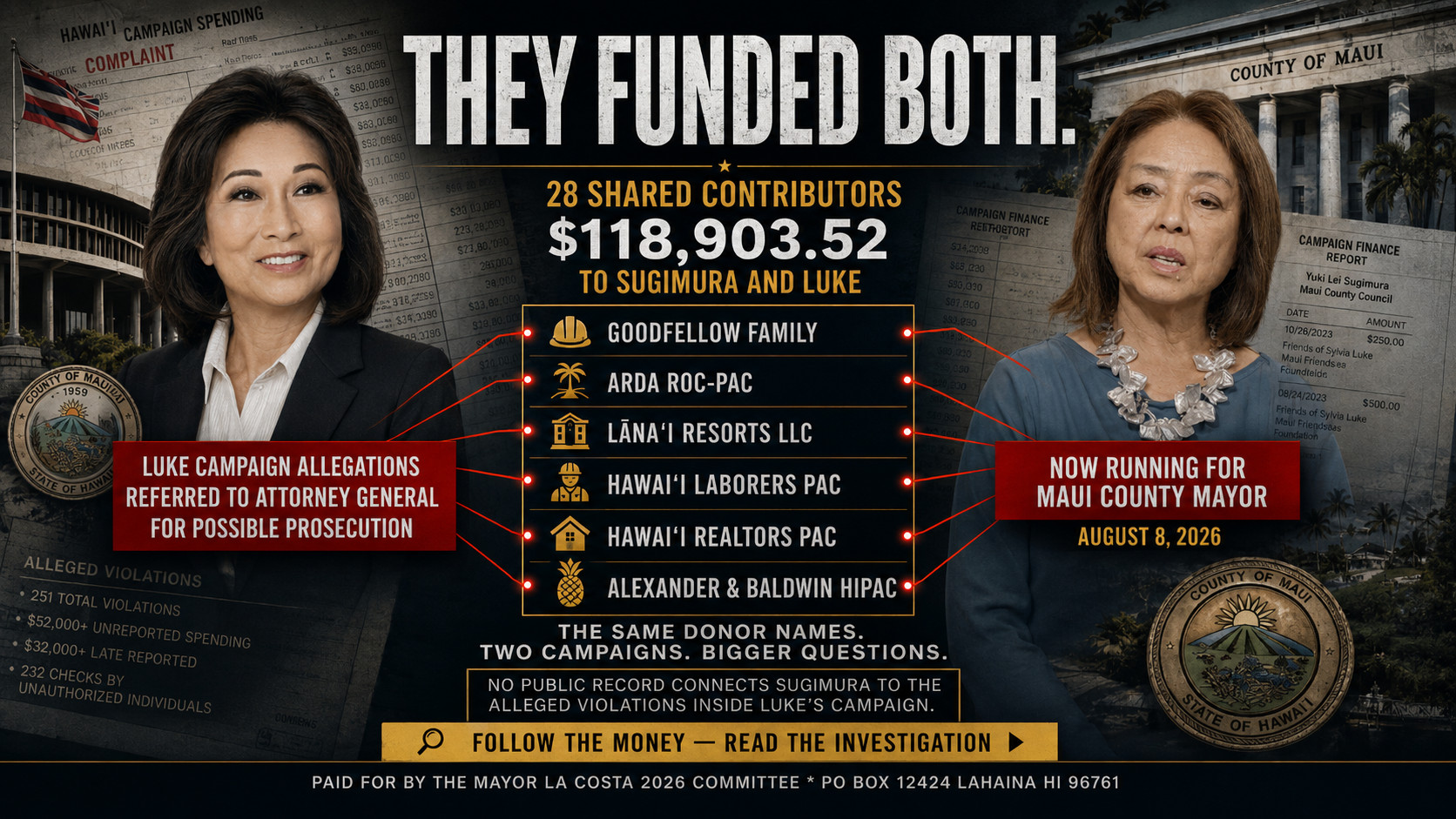
The donors who funded Yuki Sugimura’s rise to power also financed a lieutenant governor’s campaign. On July 8, 2026, that campaign was referred to the state Attorney General for possible criminal investigation or prosecution. This is the story of the network that connected them.
On Oct. 16, 2025, a $250 expense appeared in the campaign ledger of Maui County Council Vice Chair Yuki Lei Sugimura.
It sat among ordinary political expenses — storage fees, printing, airline tickets, admission to community events. The recipient was Friends of Sylvia Luke. The stated purpose was “Maui fundraiser 10-16-2025.”
At the time, it looked like a routine ticket: one politician’s campaign attending another politician’s fundraiser. Nothing in the record suggests the ticket itself violated campaign law.
Nearly nine months later, its context had changed entirely.
On July 8, 2026, the Hawaii Campaign Spending Commission voted to refer allegations involving Luke, her campaign, and several people who handled its finances to the state Attorney General for possible criminal investigation or prosecution. The vote was unanimous among the three participating commissioners; a fourth recused himself because he had donated to Luke’s campaign before joining the commission, and one seat was vacant. The complaint alleged 251 violations of state campaign finance law — more than $52,000 in unreported spending, more than $32,000 in late-reported contributions, and 232 checks allegedly signed by individuals not reported to the Commission as authorized to handle campaign funds.
“These are not minor technical errors.” — Commission General Counsel Eunice Park, July 8, 2026
Those words, Park told the commission, described a campaign run by someone with “more than 24 years of legislative and political campaign experience.” The commission declined to impose the alternative $28,300 fine, choosing referral instead.
Under Hawaii law, reckless, knowing, or intentional campaign-finance violations are generally misdemeanors. Certain knowing or intentional conduct — including falsifying a required report with intent to circumvent the law or deceive the Commission — can constitute a class C felony.
The commission chairman emphasized the referral is not a finding of guilt, and the Attorney General will decide whether to investigate further, decline the matter, or bring charges.
Two days later, Yuki Lei Sugimura is asking Maui voters to make her mayor.
The $250 ticket did not connect Sugimura to those alleged violations. But it presented a question: Was the fundraiser an isolated political courtesy — or one visible point in a wider financial relationship?
The answer was in the donor files.
A comparison of Sugimura’s three council campaigns against Luke’s 2022 lieutenant governor campaign found 28 exact normalized contributor-name matches — donors who gave money to both politicians. Those shared contributors gave $45,403.52 to Sugimura and $73,500 to Luke — $118,903.52 combined.
| Shared donors: what the files show | |
| Contributor names in both records (exact matches) | 28 |
| Given to Sugimura by shared donors | $45,403.52 |
| Given to Luke by shared donors | $73,500.00 |
| Combined total to both politicians | $118,903.52 |
| Share of Sugimura’s itemized contributions | ~25% |
The scale looks different from each side. Luke ran statewide; her itemized contribution records total approximately $1.39 million. The shared contributors represent roughly 5 percent of that total. Sugimura’s races were smaller: the same names supplied approximately 25 percent of the itemized contributions examined from her three council campaigns.
The overlap does not prove coordination. Large unions, businesses, and political organizations commonly support multiple candidates, and nothing in these records establishes why any contributor donated, whether the campaigns coordinated, or whether any contribution influenced an official act.
What the overlap does establish is this: the interests represented — construction unions, resort and lodging organizations, real estate interests, developers, and politically active Maui families — had substantial business before both levels of government where these two politicians held budget-writing roles.
Sylvia Luke chaired the state House Finance Committee from 2013 through her 2022 election as lieutenant governor, exercising significant influence over state appropriations — the funding streams for housing programs, infrastructure, and development incentives statewide. Yuki Sugimura chairs the Maui County Council’s Budget, Finance and Economic Development Committee, giving her a central role in shaping the county budget, while the full Council adopts it and executive departments administer permitting.
For a company like Goodfellow Bros. — which reported $305 million in Hawaii revenue in 2023 — decisions at both levels of government materially affect its business. The records show its family members gave to both politicians in the same cycle. The records do not say why.
The Goodfellow contributions
The most substantial identifiable family cluster in the overlap was the Goodfellows.
Between 2020 and 2024, contributors with the Goodfellow surname gave $18,000 to Sugimura across all three council cycles. Civil Beat named them as her biggest donors in July 2022. The same family gave $11,000 to Luke’s 2022 lieutenant governor campaign. Combined: $29,000 to both politicians.
Tamar Goodfellow and Chad Goodfellow appear in both files by exact name. J. Stephen Goodfellow also gave to both campaigns, though name-entry variations (“J. Stephan” in Sugimura’s file, “J. Stephen” in Luke’s) required those contributions to be examined and reconciled manually.
In the same 2022 election cycle, J. Stephen Goodfellow — identified in Dun & Bradstreet records as a principal of Goodfellow Bros. Hawaii, Inc. and listing a Wenatchee, Washington address — gave $2,000 to Sugimura on July 6, $2,000 to Luke on September 11, and $4,000 to Luke on October 24. The same family principal, within a four-month span, contributed to a Maui County budget chair and a state lieutenant governor candidate.
In 2024, state procurement records show a legal dispute — Alpha Inc. v. County of Maui Purchasing Division and Goodfellow Bros. LLC (Hawaii DCCA, Procurement Decisions, PDH-2024-003) — in which a competing contractor challenged a Maui County contract award involving Goodfellow.
The contribution records establish alignment of interests and repeat financial relationships. They do not establish causation. No document reviewed for this report shows a donor instructing Sugimura how to vote or a contribution conditioned on any official act.
The timeshare lobby’s 24-hour double
The American Resort Development Association Resort Owners’ Coalition PAC — ARDA ROC-PAC, the national political committee of the timeshare and vacation-ownership industry — provides one of the clearest examples of parallel political giving.
On December 8, 2021, ARDA ROC-PAC contributed $1,000 to Luke’s lieutenant governor campaign. On December 9, 2021, it contributed $2,000 to Sugimura’s council campaign.
|
The 24-hour double
The same industry committee. Two contributions. Twenty-four hours apart. To two politicians at two different levels of Hawaii government — one with a central role in county tax rates and vacation-rental policy, the other chairing the committee that shaped state revenue policy. |
Over the full period examined, ARDA ROC-PAC gave $3,500 to Sugimura (2020, 2021, 2023, and 2024) and $4,000 to Luke (2021 and 2022) — $7,500 combined.
On December 15, 2025, the Maui County Council gave final approval, by a 5-3 vote, to Bill 9 — Mayor Bissen’s ordinance phasing out more than 6,200 transient vacation rentals operating in apartment-zoned districts. First reading passed December 1; Mayor Bissen signed the bill into law the afternoon of December 15. The measure addressed apartment-zoned Minatoya-list units; separately classified timeshares and bed-and-breakfasts were not phased out and continued operating. Sugimura voted no on both readings, citing concerns about tax revenue and economic effects — arguing the phase-out would cost the county roughly $65 million in real property taxes per year plus additional state excise and accommodations tax losses.
The contribution records do not establish that ARDA participated in the Bill 9 debate or that its contributions influenced Sugimura’s vote. What the records show is a pattern of parallel giving by a national industry committee to two politicians at two levels of the government that sets tax and land-use policy affecting that industry.
The family contribution
On June 23, 2022, Yuriko Sugimura — listed in Yuki Sugimura’s own campaign filings under the Campaign Spending Commission donor-type category “Immediate Family” — gave $500 to Sylvia Luke’s lieutenant governor campaign.
Earlier the same month, on June 4, Yuriko gave Yuki $2,000 for her concurrent council race.
An immediate-family contributor to Sugimura was simultaneously supporting Luke’s campaign. That does not establish a formal relationship between the two campaigns. It shows that Luke’s political support extended into Sugimura’s immediate-family donor circle.
The island owner
One entry in the shared donor list carries a dimension the others don’t.
Lanai Resorts LLC — the entity through which Oracle founder Larry Ellison holds his approximately 98 percent ownership of Lanai, operating as Pūlama Lānaʻi — gave $4,000 to Sugimura across three cycles and $2,000 to Luke, $6,000 combined.
Because Lanai is part of Maui County, county tax rates, budget appropriations, infrastructure decisions, and certain land-use matters affecting the island come before the Maui County Council, on which Sugimura serves as vice chair and budget chair. Other water-resource and land-use classification decisions fall under state or administrative jurisdiction.
Ellison’s company also owns Lanai Today, a community newspaper it purchased in 2019, and is the island’s dominant employer and landowner.
The company with the largest economic footprint on Lanai was contributing to politicians at both levels of the government that regulates it. As with every entry in these records, the contributions are legal and disclosed; the concentration of that relationship is what makes it worth reporting.
Other shared interests
Beyond the named clusters, the exact-match overlap included: the Hawaii Laborers PAC, United Public Workers PAC, Plumbers & Pipefitters PAC, Hawaii LECET PAC Fund, Hawaii Hotel Alliance, and Alexander & Baldwin’s political committee.
Alexander & Baldwin — one of Hawaii’s largest private landowners, with extensive real estate holdings on Maui — appears in both contribution records. Its interests in county land-use decisions, permitting policy, and infrastructure investment are substantial and well documented.
Two additional organizations appear in both files under slightly different registered names and were reconciled manually rather than by exact match: the Hawaii Realtors political committee (filed as “Hawaii Realtors PAC” in Sugimura’s records, $4,000; and as “Hawaii Realtors Political Action Committee” in Luke’s, $6,000) and the ILWU Local 142 Hawaii PAC ($4,300 to Sugimura under “ILWU Local 142 Hawaii PAC account”; $6,000 to Luke under “ILWU Local 142 Hawaii PAC”). These are treated as probable same-entity matches and are disclosed here separately from the 28 exact matches.
These are not anonymous contributors. They represent industries with material interests in the decisions made by the politicians they supported.
The 232 checks
The most striking detail in the Luke complaint is not the referral itself. It is an allegation inside it: 232 checks on Luke’s campaign account, reportedly signed by individuals not reported to the Commission as authorized to handle campaign funds, across a period running from July 2021 through December 2022.
The public record reviewed for this report does not establish how many individuals were responsible for those 232 checks, who they were, or what interests they represented. Those facts, if they emerge, will come from the Attorney General’s review.
What can be said from the public record: the commission’s general counsel called the alleged conduct “not minor technical errors,” and the commission voted to place the matter before prosecutors rather than resolve it with a fine.
The carpenters — on both sides
The financial relationship between Sugimura’s donor base and Luke’s includes one apparent contradiction worth understanding rather than glossing over.
In 2022, the carpenters-backed super PAC Be Change Now spent heavily in the lieutenant governor’s race — supporting Luke’s opponent Ikaika Anderson and running advertising against Luke. (Civil Beat, December 2022) Separately, the Hawaii Carpenters PAC contributed to Sugimura across multiple council cycles.
At the same time, individual construction-industry contributors — including Goodfellow-surname donors — were contributing to Luke. These are distinct organizations and individuals; their political activity does not move as a single actor.
The records document both facts. They do not explain them. Institutions and the individuals within their orbit frequently support different candidates in the same race, for reasons the records do not capture.
What is documented is where the relationships stand now: In March 2026, the Hawaii Regional Council of Carpenters — the state’s largest construction union — formally endorsed Sugimura for mayor. (Maui News, March 28, 2026) For A Better Tomorrow — the carpenters-connected super PAC that spent more than $290,000 supporting three of Sugimura’s council allies in October 2024 (Civil Beat, October 30, 2024) — reported $12.46 million on hand at the start of 2026. (Civil Beat, May 2026) It has not announced independent expenditures in the mayoral race, and by law it cannot coordinate with any candidate’s campaign.
The full picture
Official Campaign Spending Commission summaries show Sugimura’s fundraising grew nearly 80 percent over three council cycles:
| Cycle | Official Total |
|---|---|
| 2020 | $48,403.08 |
| 2022 | $73,398.52 |
| 2024 | $87,055.96 |
| Three-cycle total | $208,857.56 |
A conservative classification of her itemized records placed approximately $53,000 with construction and building-trades interests, $22,800 with real estate and development interests, and $16,350 with hospitality, resort, and timeshare interests. Combined: roughly $92,150 — more than 51 percent of the itemized contributions examined. These classifications are editorial judgments, not official CSC categories, and were designed to undercount rather than overstate industry money.
Civil Beat’s independent finding: Sugimura received 89 donations totaling $59,350 in the 2024 primary cycle alone — “most of it from the construction industry.” (Civil Beat, October 2024)
The companion document in this series sets out her corresponding votes on housing, including her no votes on Bill 9 and her record on affordable-housing measures across nine years on the Council.
This document sets out where the money came from — and what has happened to the broader political world it belongs to.
On October 16, 2025, Sugimura’s campaign paid $250 to Friends of Sylvia Luke for “Maui fundraiser 10-16-2025.” Nearly nine months later, that campaign was referred to the Attorney General for possible criminal investigation or prosecution.
No public record reviewed for this report connects Sugimura to the alleged irregularities inside Luke’s campaign. There is no evidence she handled Luke’s money, participated in preparing Luke’s reports, or had any role in the disputed transactions at the center of the investigation. The referral is not a criminal charge. It is not a finding of guilt.
|
What the records show
28 exact-match shared donors — $118,903.52 combined. An immediate-family contributor’s $500 check to Luke. A national industry committee’s back-to-back contributions 24 hours apart. A contractor family contributing to both politicians across the same cycle. Overlapping financial support from contributors with interests in construction, lodging, development, labor, and real estate. The records do not establish why any contributor donated, whether the campaigns coordinated, or whether any contribution influenced an official act. |
Voters choosing a mayor on August 8 — someone who would propose and administer a county budget of roughly $1.6 billion, oversee the executive departments that administer permitting, and manage the county’s role in deploying roughly $1.6 billion in federal disaster recovery funds, subject to Council appropriations and federal conditions — are entitled to that full picture.
The $250 ticket was the smallest number in the story.
It was also where the trail began.
Methodology
La Costa News Center compared Schedule A contribution records from Sugimura’s 2020, 2022, and 2024 election-cycle Campaign Spending Commission exports — 275 itemized entries totaling $180,736.26 — with a 2022-cycle export from Luke’s campaign containing 1,032 entries totaling $1,391,614.83. Contributor names were standardized for capitalization, punctuation, and spacing before matching. The 28-contributor figure reflects exact normalized matches only; entities filed under different names (including the Hawaii Realtors committee and ILWU Local 142 PAC) were reconciled manually and are disclosed separately in the text rather than counted among the 28.
The itemized exports do not equal the candidates’ official full-cycle CSC totals. Official Campaign Spending Commission election summaries are the controlling figures wherever full-cycle fundraising totals are stated. Industry classifications are editorial judgments presented as conservative estimates; individuals without a clearly documented organizational affiliation were left unclassified.
The $250 expenditure from Friends of Yuki Lei Sugimura to Friends of Sylvia Luke was verified in the Hawaii Campaign Spending Commission dataset “Expenditures Made By Hawaii State and County Candidates From January 1, 2015 Through December 31, 2025”: dated October 16, 2025, categorized as “Events & Activities,” authorized use “Directly Related to Candidate’s Campaign,” with the stated purpose “Maui fundraiser 10-16-2025.”