
Kihei’s Flood Control Plan Leaders Sat On
Mayor La Costa 2026
La Costa News Center
Accountability • Research • Maui Issues
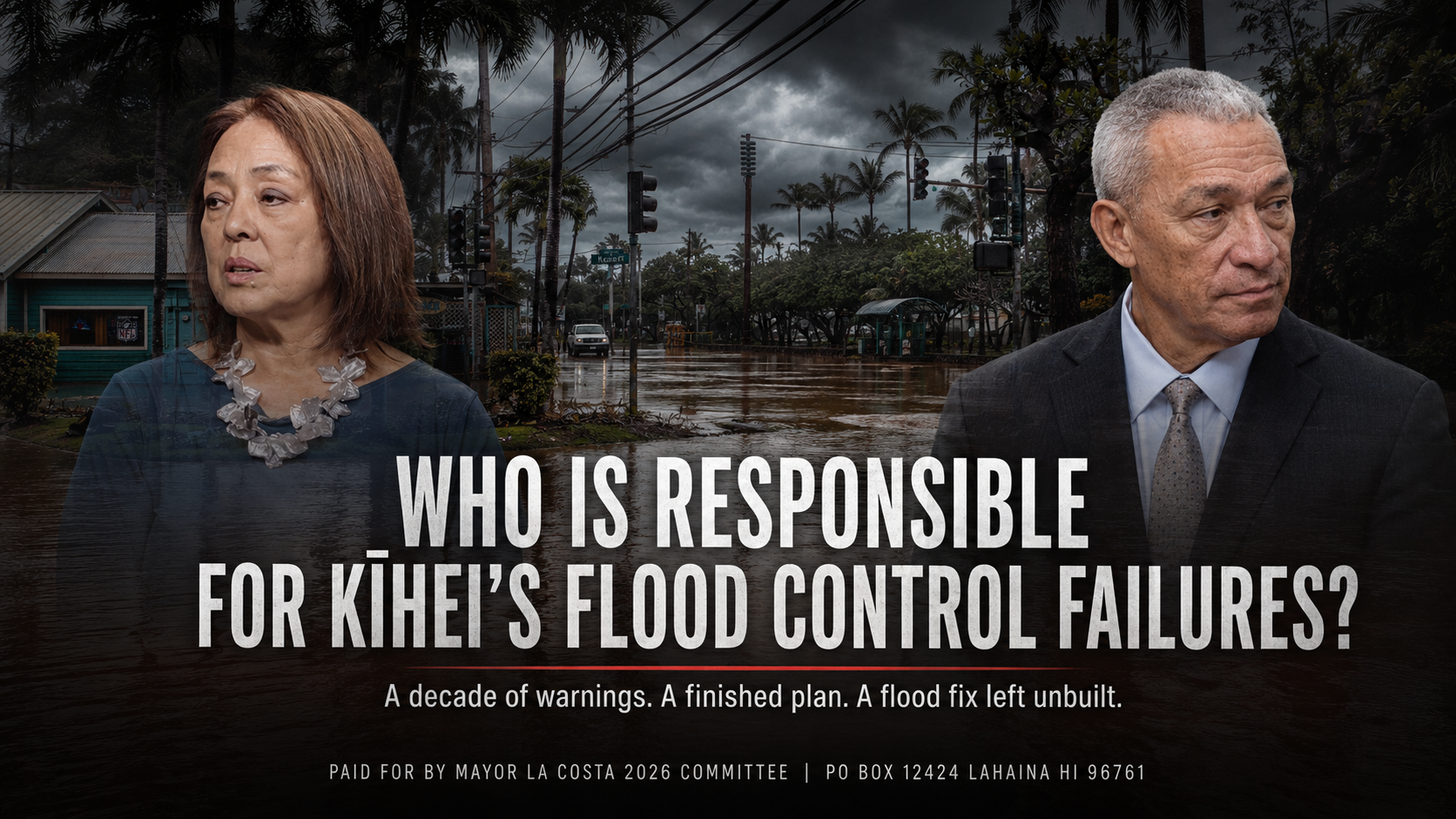
Accountability Report
The Plan on the Shelf
A decade of warnings, a finished blueprint, and the Kīhei floods Maui County studied but never stopped.
The water came up in the dark, and by morning the building was in the sea.
Susan Hungerford’s family had owned a unit at the Kīhei Kai Oceanfront Condominiums since 1974. For four decades the oceanfront complex on South Kīhei Road never flooded. Then, on the night of March 13, 2026, a Kona low stalled northwest of the islands and would not move. The National Weather Service recorded an all-time daily rainfall record at Kahului – 7.40 inches in twenty-four hours. By early Saturday, the back three-quarters of the sixteen-unit A Building had dropped roughly ten feet, and some 100,000 cubic yards of earth had slid into the ocean. The building was gone.
Hungerford had flown off-island the Tuesday before. “I’m so glad I didn’t know it was the last time I would say goodbye to those people,” she told Maui Now. “Most of them we’ll never see again.”
A few miles north, an 83-year-old named Ludeane Bonner stood in three feet of water in the home she had kept for twenty-five years; down the coast, the resident manager at Kīhei Kai, Michael Casey – who had already lost his last home in the 2023 Lahaina fire – watched the floodwater take everything a second time. “This is my third evacuation and second complete disaster,” he said.
It is tempting to file what happened at Kīhei Kai under the heading of weather – a hundred-year storm, an act of nature, the kind of thing no government can be expected to prevent. That is, in fact, roughly what the county said. But the documentary record tells a less forgiving story. The flooding that destroyed homes in March 2026 had been forecast, in engineering detail, in the county’s own commissioned studies, for the better part of a decade. The plans existed. The price was known. What never came was the building.
The record the county kept on itself
The first plan is now ten years old. In 2016, the Department of Public Works commissioned the engineering firm R.M. Towill to produce a Kīhei Drainage Master Plan. It proposed a system of detention basins and culvert upgrades and flagged the undersized culverts along South Kīhei Road that could send floodwater four to six feet above the roadway in a major storm. The community objected to its heavy reliance on concrete channels, and the county set it aside and commissioned an alternative.
That alternative – the Ecological Alternatives Analysis, prepared by EcoSolutions and completed in September 2020 – proposed nature-based options at a fraction of the cost. Then it disappeared inside the administration. For fourteen months the Kīhei Community Association could not get a copy. “Repeated attempts to learn the whereabouts and status of the report have been fruitless,” the association’s president wrote in October 2021. It took the threat of legal action by an environmental scientist, Robin Knox, to pry the document loose that November. “We still are not aware why the DPW refused to release the plan until they were forced to do so,” the association stated publicly.
A finalized, 405-page Kīhei Drainage Master Plan followed in December 2022. According to Honolulu Civil Beat, the county paid its engineering consultants $662,800 to produce it, and the plan identified roughly $200 million in flood-mitigation projects. The engineering was blunt about the scale of the mismatch between the infrastructure in the ground and the water the sky delivers: at the Kūlanihākoʻi crossing of South Kīhei Road, culverts built to carry a few hundred cubic feet per second face modeled hundred-year flows in the thousands. The chokepoints were named. The fixes were drawn. The plan even carried a phasing schedule – a first tranche of detention basins along Piʻilani Highway, estimated by the engineers at roughly $13.5 million and five to ten years of work.
Those plans exist. The solutions are known. What has not followed is implementation at the scale required.
Studies, not shovels
This is the center of the matter, and it is not in dispute. More than three years after the master plan was finalized, Civil Beat reported in May 2026, the county had not taken steps to build the phase-one detention basins – or any of the others. None of the plan’s projects appeared on the Department of Public Works’ lists of completed or upcoming capital projects.
What the county funded instead was more study. For the two fiscal years preceding the storms, Civil Beat found, the County Council budgeted one million dollars a year for Public Works to conduct hydraulic studies and surveys of the streams – not to break ground. The pattern outlived the disaster: the budget signed into law in June 2026 again set aside a million dollars for “continuing work” on the plan. A former South Maui councilmember, Kelly King, put the frustration on the record: “We should not be doing any more studying at this point.”
Money did move for pavement. The county’s six-year capital program carries a roughly $40.7 million North-South Collector Road, backed by a $25 million federal grant secured in 2023. The Public Works director, Jordan Molina, told Civil Beat the county’s priority in South Maui was maintaining access along that road. He was equally candid about the drainage plan’s limits – and his candor is a fact the honest version of this story has to carry: “We’re not going to stop flooding in Kīhei with any of these projects,” he said. “It’s more of how do we become better at managing through it.”
That caveat matters, and it sets the honest ceiling on the whole argument. The plan on the shelf was never going to end Kīhei’s floods; the geography and the storms are too much for any culvert. What it would have done is address the major, named, engineered causes of the chronic flooding – the undersized crossings, the missing detention, the water that has nowhere to go but through people’s living rooms. The promise the record supports is not “stop the floods.” It is “build the fixes that were finished and funded studies but never construction.” The county studied that fix for ten years and did not build it.
Where accountability lies – and where it does not
A fair accounting has to be precise about who is answerable for what, because the failures here belong to different hands.
The most damning specifics in the record are the administration’s. It was the administration that let the EcoSolutions report sit for fourteen months. It was the administration that denied Kīhei Kai’s condominium association a timely permit for permanent foundation repairs, leaving the building in its patched, emergency-repaired state when the March storms arrived. It was the administration that rebuilt the Waiakoa Gulch bridge that residents describe as “literally a dam,” with two culverts too small for the water. And it was the mayor, Richard Bissen, who told more than 150 residents at a March 31 recovery meeting that his administration would take its share of blame – and then added: “But let’s just give some credit to Mother Nature, doing whatever she’s going to do. She’s always going to win.”
The Council’s share is different, and it runs through the budget – which is to say, through Yuki Lei Sugimura. Since 2023 she has chaired the Budget, Finance and Economic Development Committee, the body that writes the county’s spending priorities; from 2021 to 2023 she chaired the Infrastructure and Transportation Committee before that. The county does not fund construction by accident. The budgets her committee wrote, in the years after the plan was finished, found a million dollars annually for more studies of Kīhei’s streams. They found roughly $40 million, and a $25 million federal grant, for a South Maui road. They did not find money to build a single one of the detention basins the finished plan called for.
The Budget Gavel
The chair who called the budget “fat” was chairing the budget that funded another round of Kīhei studies and not one of the basins. The money was not missing. By her own description, there was a surplus of it – while the plan to hold back the water stayed on the shelf for want of funding.
And here the ledger turns from neglect to something harder to explain. The county was not short of money in these years – by the budget chair’s own account, it had too much. In an April 2025 budget session, eleven months before the storms, Sugimura told her committee that carryover savings of that magnitude were “questionable,” that the Council had to weigh “how this impacts… the taxpayers,” and, surveying the amendments on the table, that “there’s fat in the budget.” Her committee would later formalize the point, flagging nearly $200 million in carryover as raising “profound concerns about potential overtaxation of County residents.” Set that against the drainage file and the arithmetic is stark.
This is the accountability of the budget gavel, and it does not require a smoking-gun vote to be real. A budget chair answers for what the county builds and what it does not – for the whole island, regardless of which district floods. That is the job, and it is precisely why the Upcountry seat she holds is no defense: the gavel is countywide. The question a voter is entitled to ask is the one the record poses directly. If the money existed – if it existed in such quantity that the chair herself called it fat, and her committee called it overtaxation – why was none of it turned into the fix that engineers had specified, costed, and finished four years earlier?
The sequence
The Department of Public Works commissioned the original Kīhei Drainage Master Plan.
An ecological alternatives analysis was completed, then sat unreleased for fourteen months.
A finalized 405-page Kīhei Drainage Master Plan identified roughly $200 million in flood-mitigation projects.
The county funded more studies while the phase-one detention basins remained unbuilt.
The March storms hit Kīhei, destroying homes and exposing a decade of delay.
The public record assembles into a sequence that is hard to read as anything but choice. A plan in 2016. A suppressed alternative in 2020, released only under legal pressure in 2021. A finished, $200 million blueprint in 2022. Then three budget cycles of studies while the basins went unbuilt and a $40 million road moved ahead – and, layered over all of it, a budget chair calling the surplus “fat” in the spring before the storms that would put a building into the ocean.
The campaign of P. Denise La Costa, the former Planning Commission chair now running for mayor, compiled much of this record into a sourced accountability report and published it on April 9, 2026, while South Kīhei Road was still closed. Civil Beat’s deeper investigation – the one that pulled the contract figure and the budget lines and put the Public Works director on the record – followed four weeks later, on May 7. The two arrived independently at the same finding, the one the Kīhei Community Association had been stating for years: the plans existed, the solutions were known, and the county did not build them.
The county had a plan for where to start. It had, by its own chair’s account, the money. For ten years, it studied instead.
Ludeane Bonner was staying with family when reporters found her, the water still standing in the house she had kept for a quarter century. “This is one of those moments,” she said, “where you just have to stand and say, ‘Where do I start?'”
One Comment